Stop paying for
your neighbour's EV.
When EV chargers spike the building's peak power demand, the power charge bill lands on everyone — including residents who don't own a car. KotiCharge measures who caused the peak and bills them for it. Everyone else pays less.
Problem 1 — Unfair cost sharing
EV chargers spike peak power demand. The power charge rises — and the whole building pays, including residents without a car.
Problem 2 — EV owners pay twice
EV owners already pay for their electricity usage. But through the shared power charge, they also pay for the peak they caused — hidden inside every resident's maintenance fee.
KotiCharge solution
Measure each charger's peak contribution, bill it to the right resident. Optionally cap peak load so spikes never happen. Everyone pays exactly their share — nothing more. Residents who charge overnight pay zero power charge — peaks don't occur at night.
3
monthly peaks determine the power charge
100%
of EV-caused peak cost billed to EV owners
€0
extra power charge for non-EV residents
Auto
monthly report with full peak breakdown
The background
What is power charge — and why do EVs make it worse?
How power charge is calculated
Your grid operator measures the building's power draw every hour. At the end of the month, they take the three highest hourly peaks and calculate the average. That number, in kilowatts, is multiplied by the network tariff rate — and charged to the housing company.
Typical network tariff: ~€5 / kW / month. Example: a 30 kW peak = ~€150/month for the whole building.
Why EV chargers spike the peak
EV chargers draw 7–22 kW each. When several residents arrive home at the same time and plug in, the combined load creates a sharp evening peak. A building that previously peaked at 30 kW can suddenly see 80–100 kW spikes — multiplying the power charge two to three times.
The solution
How KotiCharge makes it fair
Two tools working together — attribution and prevention.
Tool 1 — Peak attribution
Measure who caused the peak, bill them for it
- During each hourly peak, KotiCharge records how much power each charger was drawing
- Each charger's share of the peak is calculated as a percentage of the total EV load
- That percentage of the month's power charge is billed to the resident who caused it
- Residents who charged overnight — when no peak occurred — pay nothing extra
Tool 2 — Power cap
Limit EV load during peak hours — prevent spikes entirely
- Set a maximum combined power limit for all EV chargers during defined peak hours (e.g. 07:00–21:00)
- When the limit is reached, KotiCharge automatically throttles charging across active sessions
- The building's peak stays predictable — power charge stays low for everyone
- Overnight the cap lifts, chargers run at full speed, cars are ready by morning
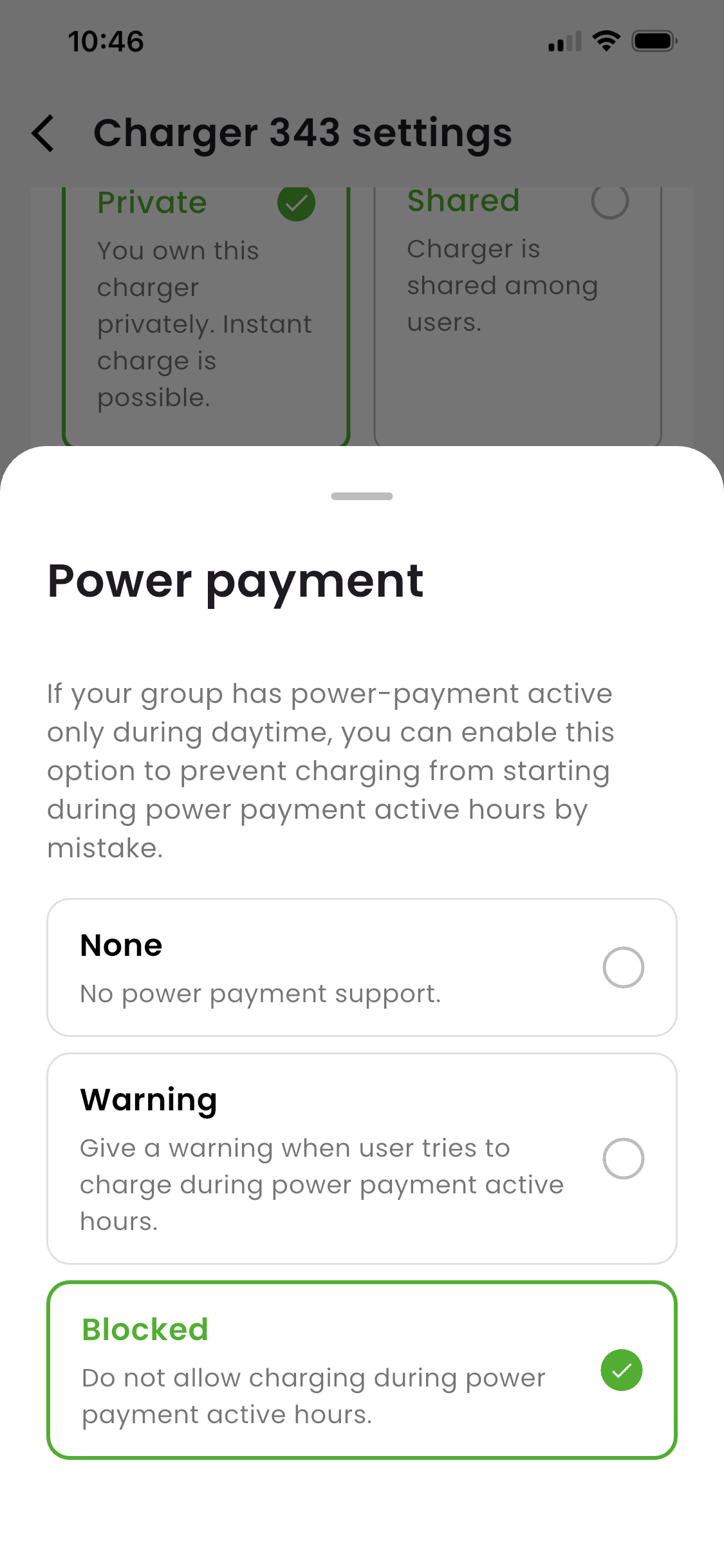
KotiCharge app — peak hour settings
Residents choose how they want to handle peak hours
During defined peak hours the app gives each resident full control. They pick the mode that fits their schedule — no surprises, no hidden charges.
-
Charge and pay
Charge normally during peak hours and pay the resulting power charge share. Maximum flexibility.
-
Warn me
The app sends a notification before starting a peak-hour session — the resident confirms or delays.
-
Block charging
Peak-hour sessions are prevented entirely. Car charges automatically once the peak window closes.
The result: EV owners pay their fair share — and only their fair share
The EV-caused power charge is collected from EV owners individually, just like their electricity usage. Non-EV residents see no change in their maintenance fee. Property managers get a monthly breakdown showing exactly how the power charge was split.
For EV owners
Stop paying twice for your EV.
Without KotiCharge, EV owners already pay for the electricity they use — and then again, hidden inside the building's maintenance fee, for the power charge their charging caused. That's a double charge most residents never even notice.
With KotiCharge, the power charge share is calculated, attributed, and billed directly. You see exactly what you owe — and the maintenance fee for the whole building stays fair.
Without KotiCharge
Electricity usage
paid via charger invoice
Your share of power charge
hidden in maintenance fee — shared with everyone
Non-EV residents' subsidy
you pay part of their share too
With KotiCharge
Electricity usage
exact spot-price or fixed rate
Your power charge share
only what your charger caused — billed directly
Non-EV residents' subsidy
their maintenance fee stays unchanged
For property managers
The power charge report — ready for your books.
Every month KotiCharge produces a full breakdown — no manual calculation needed.
Peak event log
Each of the three monthly peak hours listed with time, total building power, and EV charger contribution.
Per-resident attribution
Each EV owner's share of the peak load and corresponding power charge amount — ready to bill or attach to accounting.
Housing company summary
Total power charge for the month, and a breakdown of power charge contribution from each resident.
Common questions
Frequently asked questions
What is power charge?
Why do EV chargers increase the power charge?
How does KotiCharge split the power charge fairly?
Does the power cap affect comfort or charging speed?
Ready to make EV charging effortless for everyone?
Join housing companies and businesses across Finland who trust KotiCharge to handle billing, savings, and everything in between.
Average switching time from another operator: under 10 min · No disruption to residents
35
cities across Finland
500
charging locations
2000
chargers managed